How to Fix Your Sleep Schedule (Even If You’ve Tried Everything)

If you are wondering how to fix your sleep schedule after weeks of late nights, irregular bedtimes, or shift work — you have come to the right place. Knowing how to fix a sleep schedule is not about willpower or forcing yourself to bed earlier. It is about understanding the two biological systems that control your sleep and using specific, science-backed techniques to realign them. This guide covers exactly how to fix your sleep schedule — even if you have tried everything before and failed.
🌙 Start tonight: Use the WakeCalc Sleep Cycle Calculator to find the perfect bedtime for your target wake-up time — free and instant.
Why Your Sleep Schedule Gets Disrupted
Before learning how to fix your sleep schedule, it helps to understand why it breaks in the first place. Your sleep is controlled by two main biological systems:
1. Circadian Rhythm — Your internal 24-hour clock that regulates when you feel sleepy and alert. It is primarily set by light exposure — morning sunlight and evening darkness.
2. Sleep Pressure (Adenosine) — A chemical that builds up in your brain the longer you stay awake. The more it accumulates, the sleepier you feel. Sleep clears it out completely.
According to the Sleep Foundation, when these two systems get misaligned — from irregular schedules, shift work, travel, or excessive artificial light at night — your sleep schedule falls apart. The fix requires resetting both systems simultaneously.
How to Fix Your Sleep Schedule — The 7-Step Reset
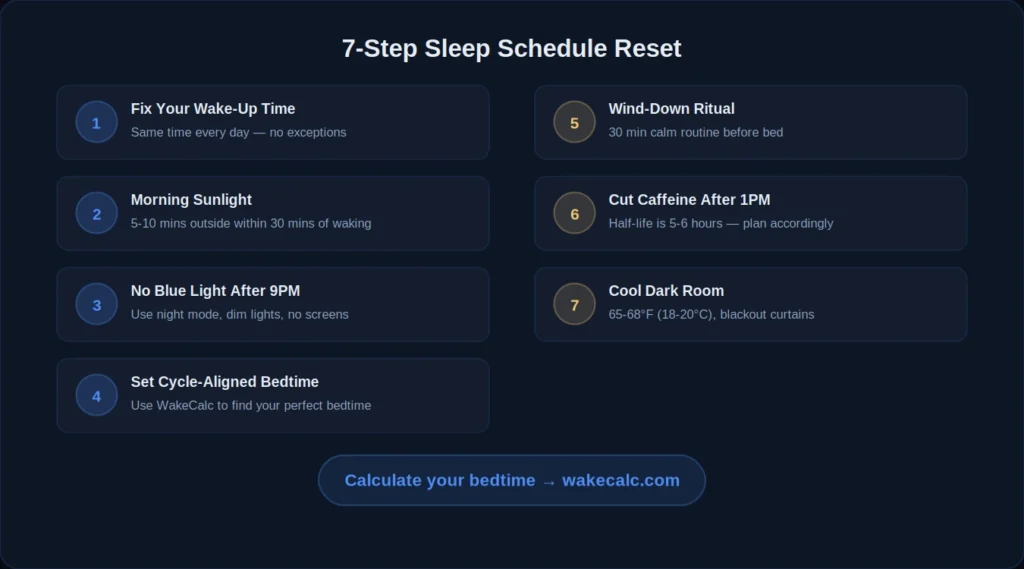
Step 1 — Pick One Fixed Wake-Up Time and Commit
The single most powerful step in how to fix your sleep schedule is choosing one consistent wake-up time and treating it as non-negotiable every day — including weekends. Your circadian rhythm anchors primarily to your wake time, not your bedtime. A consistent wake time is the foundation everything else builds upon. Use WakeCalc to find the bedtime that aligns with your chosen wake time in complete 90-minute cycles.
Step 2 — Get Bright Light Immediately After Waking
Within 30 minutes of waking, get outside or sit near a bright window for 5–10 minutes. Morning sunlight triggers cortisol release and firmly sets the timing of your entire circadian rhythm for the day. This is the most powerful biological signal for how to fix your sleep schedule — more effective than any supplement or sleep tracker.
Step 3 — Eliminate Blue Light After 9 PM
Artificial blue light from phones, laptops, and TVs signals your brain that it is still daytime, suppressing melatonin production. This is one of the most common reasons sleep schedules stay broken. After 9 PM: enable night mode on all screens, switch overhead lights to warm dim settings, and avoid screens entirely in the final 30–60 minutes before bed.
Step 4 — Set a Cycle-Aligned Bedtime
The key to how to fix your sleep schedule permanently is choosing a bedtime that completes whole 90-minute sleep cycles. For example, if you wake at 6:30 AM and want 5 cycles (7.5 hours), your bedtime is 10:45 PM accounting for 15 minutes to fall asleep. The WakeCalc Sleep Cycle Calculator calculates this instantly for any wake time.
Step 5 — Create a 30-Minute Wind-Down Ritual
Your brain needs a consistent transition between daytime alertness and sleep mode. Dim lights 45–60 minutes before bed, avoid stimulating news or social media, and try reading, light stretching, or meditation. Keep the same routine every night — consistency builds the neurological association between the routine and sleep.
Step 6 — Manage Caffeine Strategically
Caffeine has a half-life of approximately 5–6 hours. A 3 PM coffee still has half its caffeine in your system at 9 PM. For most people, cutting caffeine after 1–2 PM is the right approach when learning how to fix a sleep schedule. Hidden caffeine sources — tea, chocolate, pre-workout, some pain relievers — are often overlooked.
Step 7 — Keep Your Room Cold and Dark
Your core body temperature must drop about 1–2°F to initiate and maintain sleep. The CDC recommends a bedroom temperature of 65–68°F (18–20°C) for optimal sleep. Complete darkness is equally important — even small amounts of light from electronics suppress melatonin. Use blackout curtains or a sleep mask.
How Long Does It Take to Fix a Sleep Schedule?
With consistent implementation of these 7 steps, most people see significant improvement in how to fix their sleep schedule within 1–2 weeks. Moving your schedule earlier by 1–2 hours typically takes one week. Larger shifts of 3+ hours can take 2–4 weeks of consistent effort. The key word is consistent — skipping the steps on weekends resets your progress.
What NOT to Do When Fixing Your Sleep Schedule
- ❌ Don’t sleep in on weekends — even 1–2 hours of extra weekend sleep shifts your clock back significantly and make you feel groggy everytime.
- ❌ Don’t nap longer than 20 minutes — long naps reduce sleep pressure and sabotage your ability to fall asleep at the right bedtime
- ❌ Don’t lie in bed awake for more than 20 minutes — get up, do something calm, return when sleepy
- ❌ Don’t use alcohol as a sleep aid — it fragments sleep cycles and makes your schedule harder to fix
- ❌ Don’t check your phone when you wake at night — light and mental stimulation makes returning to sleep much harder
Special Situations
Shift Workers
How to fix your sleep schedule as a shift worker is genuinely more challenging. Focus on consistency within your shift pattern, use blackout curtains for daytime sleep, and use bright light therapy at the start of your shift to signal “morning” to your biology.
Night Owl Genetics
If you genuinely cannot fall asleep before midnight regardless of effort, you may have a delayed circadian phase — a real biological condition, not just a bad habit. A sleep specialist can help with chronotherapy or timed light therapy protocols specifically designed for this.
Frequently Asked Questions
How quickly can you fix a sleep schedule?
With consistent application of a fixed wake time, morning light exposure, and evening darkness, most people see meaningful improvement in 7–14 days. Complete resetting of a severely disrupted schedule can take 2–4 weeks.
Should I pull an all-nighter to fix my sleep schedule?
This is sometimes suggested but rarely necessary. Staying awake all night builds massive sleep pressure forcing earlier sleep the next night — but the side effects of severe cognitive impairment make it a last resort. The gradual 7-step approach above is safer and equally effective for how to fix your sleep schedule.
What is the best bedtime for a healthy sleep schedule?
Research suggests sleeping between 10 PM and midnight is associated with the best health outcomes for most adults. However, the best bedtime for you is whatever allows 5 complete sleep cycles before your required wake time. Use the WakeCalc Calculator to find your exact optimal bedtime.
Now you know exactly how to fix your sleep schedule — it comes down to consistent timing, strategic light exposure, and aligning your bedtime with complete sleep cycles. Start with Step 1 tonight: pick your wake time, then use the WakeCalc Sleep Cycle Calculator to find the perfect bedtime that completes 5 full cycles. One consistent week and you will feel the difference.
Find Your Target Bedtime Right Now
Enter your wake-up time and WakeCalc shows you exactly when to sleep for 4, 5, or 6 complete sleep cycles.
Calculate My Bedtime →